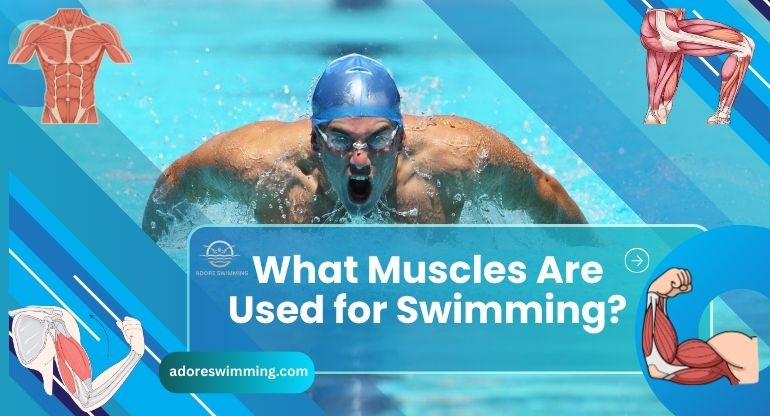
What Muscles Are Used for Swimming?
Swimming is a full-body workout. Whether you’re swimming for fun or training for competition, almost every muscle in your body is engaged. But each swimming stroke activates different muscles, and understanding which muscles are used can help you improve in each stroke and not become injured.
Totally, the answer to this question: what muscles are used for swimming? Is :
- Upper body muscles (lats, shoulders, chest, arms, upper back) for pulling water
- Core muscles (abdominals, lower back) for stability and rotation
- Lower body muscles (quadriceps, hamstrings, glutes, calves) for kicking
What are the Main Muscles Used in Swimming?
1. Upper Body Muscles
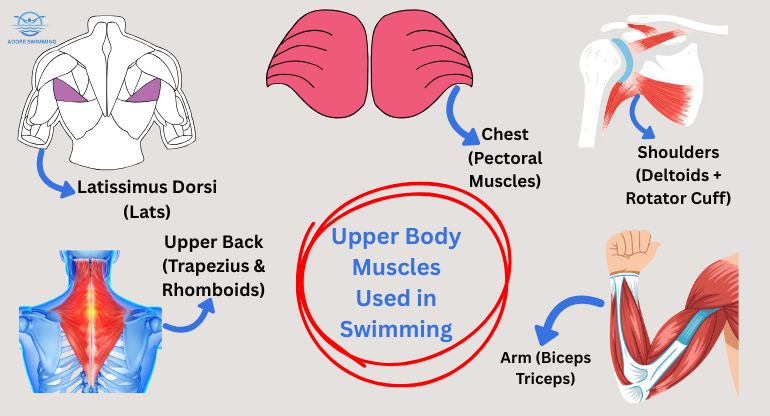
Latissimus Dorsi (Lats)
These are your primary pulling muscles. They generate power during each arm pull, especially in freestyle, butterfly, and backstroke.
Shoulders (Deltoids + Rotator Cuff)
Your shoulder muscles lift and rotate your arms, which is essential in every stroke. They help control arm movement as you reach forward and pull back through the water.
Chest (Pectoral Muscles)
The chest muscles help push water backward, especially during freestyle, butterfly, and breaststroke.
Arms
- Biceps: help in pulling water
- Triceps: Extend arms during the stroke recovery and push phase
Upper Back (Trapezius & Rhomboids)
Help stabilize the shoulder and upper body, like your arms. After a long swimming session, you will feel sore in your shoulders and upper back, which will help you understand how much these muscles are engaged — answering the question: What Muscles Are Used for Swimming?
2. Core Muscles
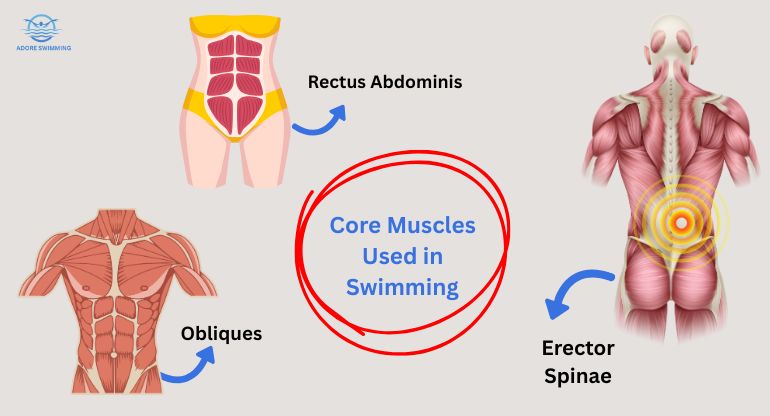
Your core is the powerhouse of your swimming performance.
Abdominals (Rectus Abdominis + Obliques)
These muscles will keep your body aligned in the water. When you stay streamlined in the water, your stroke will feel more powerful without extra effort.
Lower Back (Erector Spinae)
Maintains posture and prevents the hips from sinking. If your lower back is strong or becomes strong, your hips will be lifted, so your body stays horizontal and keeps you moving smoothly.
Why the Core Matters in Swimming? If your core doesn’t have that much strength, your legs will drop, and your waist tries to stay floating, so it needs a lot more energy for it.
3. Lower Body Muscles
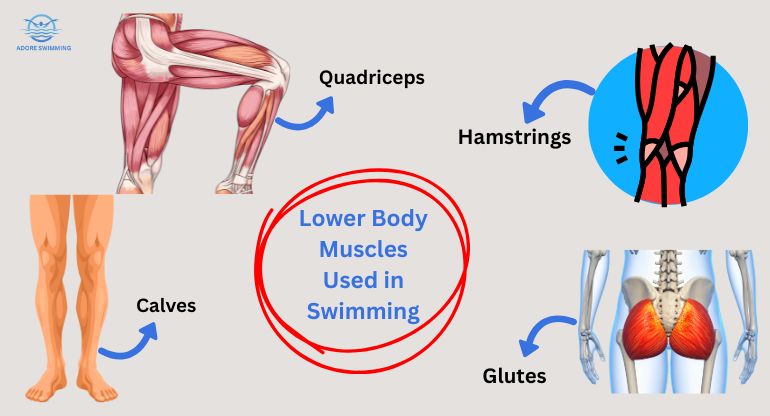
The lower body plays a major role in speed and balance in the water.
Quadriceps
These muscles help drive your legs up and down quickly with power, which can add extra speed to your stroke. You can feel a burn in your quads while you start kicking harder or doing it long-distance.
Hamstrings
Assist in hip extension and controlled kicking movement.
Glutes
These muscles provide Powerful hip drive, keep legs aligned, and help maintain a horizontal body position. When swimmers use their glutes, their hips stay higher in the water, and their stroke becomes faster.
Calves
Provide whip-like propulsion in flutter and dolphin kicks.
Muscles Used in Each Swimming Stroke
| Swimming Stroke | Upper Body Muscles | Core Muscles | Lower Body Muscles |
|---|---|---|---|
| Freestyle (Front Crawl) | Lats, Deltoids, Trapezius, Biceps & Triceps | Abs, Lower Back, Obliques | Glutes, Quadriceps, Calves |
| Butterfly | Lats, Shoulders, Chest, Triceps | Abs, Lower Back | Glutes |
| Backstroke | Lats, Deltoids, Trapezius, Rhomboids | Core Stabilizers | Glutes, Hamstrings, Calves |
| Breaststroke | Chest (Pectorals), Shoulders, Biceps | — | Inner Thighs (Adductors), Glutes, Hamstrings, Calves |
If you’re wondering which swim stroke helps you build the most muscle, check out this guide: Which swimming stroke builds the most muscle?
FAQs:
What muscles are used most in swimming?
your back (especially lats), shoulders, core, and legs work the hardest in swimming. if you swim with good technique, you repeatedly engage your core, lats, and triceps.
Can you get fit by just swimming?
It really depends on you and your body. For me, swimming alone wasn’t enough; I added running and weight lifting, and in this case, I got fit. But Many swimmers report that swimming alone improves.
Will swimming twice a week tone my body?
Twice a week for toning your body is not enough. At least 3 times is needed for your body to tone up. And some swimmers add weight training so that they can get results faster.
What muscles should you train to swim faster?
- Core muscles; for better body position and power transfer
- Back and shoulders (lats, traps) ; for stronger pulls
- Leg muscles (glutes, quads, calves) ; for better kick propulsion
What's more important in swimming, arms or legs?
You know, first you think it’s a full-body activity, but after you become more professional in swimming and your speed becomes more important to become a champion, you will understand that arms are so important to be more powerful. One stroke ahead can make you a champion.
What part of your body does swimming tone?
Swimming can tone almost every part of the body. But changes in these parts become more obvious: shoulders, back, arms, abs, and legs. shoulders and core first.
What muscles are used in freestyle swimming stroke?
Freestyle (Front Crawl) engages the upper body (lats, shoulders, traps, arms), core (abs, obliques, lower back), and lower body (glutes, quads, calves).
What muscles used in swimming breaststroke?
Breaststroke engages the upper body (pectorals, shoulders, arms), core (abs, obliques, lower back), and lower body (glutes, quads, hamstrings, calves).
What Leg muscles used in freestyle swimming?
Freestyle swimming engages the leg muscles, including:
- the glutes
- quadriceps
- hamstrings
- calves
What muscles does swimming not work?
Swimming does not work on the forearm flexors, small hand muscles, and some deep neck muscles.
Which muscles are worked in backstroke swimming?
Backstroke swimming engages the upper body (lats, shoulders, traps, arms), core (abs, obliques, lower back), and lower body (glutes, quads, hamstrings, calves).


Leave A Comment