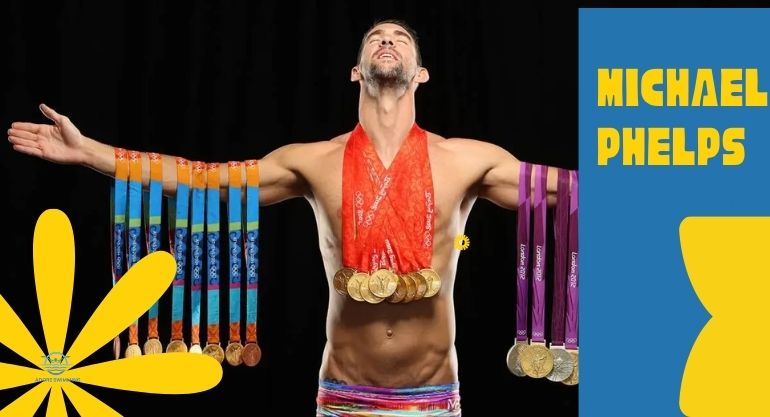
What Does Michael Phelps Have That Makes Him a Better Swimmer?
When people watch Michael Phelps race, they usually ask:
- Is it his body?
- Is it genetics?
- Is it lung capacity?
- Is it training?
- Or is it something mental?
It’s not one thing.
It’s a rcombination of:
Long wingspan for better reach
Ideal height (6’4″ / 193 cm)
Long torso and shorter legs for efficiency
Flexible ankles for propulsion
Large hands with strong technique
Excellent breath control and lung capacity (~12 L)
High lactate tolerance from training
Extreme consistency in workouts
Elite mental focus and race visualization
Obsession with technique and minimal wasted movement
Competitive drive with guidance from coach Bob Bowman
Genetics opened the door. Discipline, technique, and mental mastery made him legendary.
Let’s break it down completely.
1. Unusual Body Proportions (But Not “Superhuman”)
Phelps had:
- A wingspan longer than his height (about 6’7″); his longer wingspan gave him greater reach per stroke — meaning fewer strokes per lap.
- A relatively long torso
- Slightly shorter legs compared to his upper body
- Extremely flexible ankles (almost like flippers)
2. Michael Phelps Height
Phelps stands about 6’4″ (193 cm). This is an ideal height for elite freestyle and butterfly.
3. Michael Phelps Hand Size & Hands
Michael Phelps’s hands are described as “Built-in paddles.”
His long fingers and large palm surface area helped him catch more water per stroke. But something that you should consider is that big hands didn’t make him elite, efficient technique did.
4. Michael Phelps webbed hands
No — there is no verified evidence that he has webbed hands.
What he actually had was:
- Long fingers
- Flexible wrists
- Strong forearm engagement
- Excellent feel for the water
It wasn’t webbing, it was mechanics and leverage.
5. Michael Phelps Lung Capacity
It’s often reported that Phelps had a lung capacity of around 12 liters — roughly double that of the average adult male. You can read more about Swimmers Lungs vs Normal Lungs. But lung capacity alone doesn’t win races; what made it powerful was how he trained it.
He became famous for his underwater dolphin kick, often staying underwater longer than competitors off the wall.
That allowed him to:
- Reduce drag
- Maintain streamline position
- Conserve energy
His breath control was trained.
6. Why Does Michael Phelps Produce Less Lactic Acid?
There is no strong published scientific evidence proving he naturally produced dramatically less lactate.
What likely happened:
- Years of elite training improved lactate tolerance
- His body became highly efficient at clearing metabolic waste
- His technique reduced wasted energy
7. Insane Training Volume and Consistency
Phelps has spoken everywhere about swimming nearly every single day, even on holidays.
During peak training:
- 6–7 days per week
- Multiple sessions per day
- Hours in the pool daily
He said, There were no days off. The real difference wasn’t talent; it was the fact that he didn’t miss sessions.
8. Elite Mental Focus
Phelps explained how he visualized races in detail:
- Starts
- Turns
- Stroke timing
- Even equipment failures
During a race, his goggles filled with water — and he still won. Later, he said he had mentally rehearsed that exact situation.
His biggest advantage wasn’t physical. It was mental preparation.
9. Obsession With Technique
Slow-motion YouTube analysis shows his mastery of Swimming Strokes:
- High elbow catch
- Powerful underwater dolphin kicks
- Perfectly timed turns
- Minimal drag
- He doesn’t waste movement. Every stroke moves him forward.
- Streamline
- Wall push-offs
- Underwater phases
10. Competitive Drive
Multiple interviews reveal something deeper:
- He hated losing
- He studied competitors obsessively
- He remembered losses for years
- He used frustration as fuel
11. Coaching and Environment
His long-term relationship with coach Bob Bowman is often mentioned everywhere.
Stable coaching provided:
- Structured long-term planning
- Trust
- Technical refinement over the years
Talent without the right coach doesn’t reach that level. He had both the talent and the system.
Does Michael Phelps Have a Genetic Advantage?
Yes, but not uniquely superhuman.
He had:
- Favorable body mechanics
- Above-average lung capacity
- Strong flexibility
- Efficient stroke potential
But there are other swimmers with similar builds.
Very few had:
- His training consistency
- His mental control
- His competitive obsession
FAQs:
What makes Michael Phelps a better swimmer?
It was a combination of:
- A wingspan longer than his height (about 6'7")
- A long torso and strong core balance in the water
- Extremely efficient underwater dolphin kicks
- High-level breath control
- Years of relentless, nearly daily training
- Exceptional mental preparation
There are swimmers with similar builds. What separated him was consistency and mental discipline. So while his body helped, his discipline and mindset made the real difference.
What genetic condition does Michael Phelps have?
He does not have a confirmed genetic disorder or condition.
- There is no verified evidence that he has webbed hands.
- There is no scientific confirmation of a rare genetic disorder.
- His high lung capacity (often reported around 12 liters) is unusual, but not a medical condition.
So he had genetic advantages, not a genetic condition.
What is Michael Phelps’ special trait?
Three traits come up repeatedly:
1. Underwater Dolphin Kick: He could stay underwater longer and faster off the walls, reducing drag and conserving energy.
2. Body Proportions:
- Long wingspan
- Long torso
- Flexible ankles (almost fin-like)
- Large hands
These gave him mechanical efficiency.
3. Mental Visualization:
Phelps explained that he mentally rehearsed races over and over.
Did Michael Phelps actually eat 10,000 calories a day?
During the 2008 Olympics, media outlets reported that Phelps consumed 8,000–10,000 calories per day.
However, Phelps later clarified in interviews that the number was exaggerated.
According to Reddit discussions and his own statements:
- He did eat very high calories during intense training.
- But the “10,000 calories every day” story was largely media hype.
He consumed high carbohydrates and large meals to fuel extreme training loads, but the 10,000-calorie figure likely became inflated through repetition.


Leave A Comment