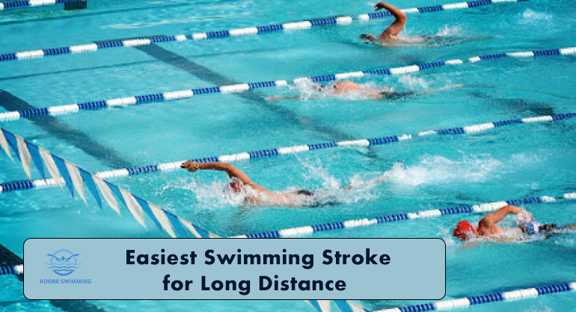
Easiest Swimming Stroke for Long Distance (Real Experience)
When people search for the easiest swimming stroke for long distance, the simple answer is: freestyle (front crawl). It uses less energy than other strokes, helps you find a steady breathing rhythm, and makes it easier to keep going for longer.
Research also supports this, showing that front crawl has the lowest energy cost among all strokes, making it more sustainable for long-distance swimming.
From both my experience and what swimmers often say on forums, it’s clear that “easy” doesn’t just mean simple — it means something you can keep doing without getting exhausted too quickly.
One important thing to keep in mind is that the “easiest” stroke can be different for each person. Everyone’s body is different, so some people naturally feel more comfortable with certain strokes and can swim longer without getting tired.
For example, while most people agree that freestyle is the easiest on average, for me personally, breaststroke feels the easiest. I can swim breaststroke for a long time without getting tired. The only issue I sometimes feel is a bit of lower back discomfort, but I just switch to floating on my back for a short time, and then I continue again. Overall, it’s still the easiest stroke for me.
Interestingly, I once asked a friend about this, and surprisingly, she said he enjoys butterfly so much that she never gets tired of it — even over longer distances.
My Experience with Long-Distance Swimming
From my own training, I’ve noticed that long-distance swimming isn’t about speed — it’s about rhythm and breathing.
When I first started swimming longer distances, I made the mistake of focusing too much on power. I would get tired quickly. But once I learned to slow down, control my breathing, and stay relaxed, everything changed.
That’s when I realized: the easiest swimming stroke for long distance is the one that helps you stay calm, breathe efficiently, and move forward with minimal effort.
What Is the Easiest Swimming Stroke for Long Distance?
For most swimmers, the answer is:
Front Crawl (Freestyle)
Freestyle is widely considered the easiest swimming stroke for long distance, not because it’s the simplest to learn at first, but because it’s the most efficient over time.
Why freestyle works best:
- You move smoothly without stopping. Once you find your rhythm in freestyle, it feels like gliding, so you don’t have to think about each stroke.
- Every stroke actually pushes you forward; With freestyle, you feel like each pull counts, and you don’t feel stuck.
- Freestyle has easy breathing patterns; you can breathe every three strokes and never feel out of breath.
- With freestyle, you don’t tire as quickly; you can swim 30–40 minutes in freestyle without feeling worn out.
- With freestyle, it’s easy to keep a steady pace; Once you hit your pace, you just keep going.
But Is Freestyle Always “Easy”?
Here’s where real experiences matter.
Many beginners say:
“Freestyle doesn’t feel easy — I run out of breath quickly.”
That’s completely normal.
From swimmer discussions:
- Beginners struggle with breath timing
- Many feel anxious because they can’t breathe whenever they want
- Poor technique leads to faster fatigue
So while freestyle is the best stroke for distance, it only becomes the easiest swimming stroke for long distance after you learn proper breathing and technique.
Why do some swimmers prefer backstroke?
Backstroke is often mentioned as another option.
- You can breathe freely (no breath restriction)
- Less stress mentally (face stays out of water)
- Good for recovery swims
However:
- It’s slower than freestyle
- Less efficient for long distances
- Harder to navigate in open water
So while backstroke feels easier, it’s usually not the best choice for long-distance performance.
Why Breaststroke Is NOT Ideal for Long Distance?
Breaststroke might seem easy at first, but for long distances, it’s surprisingly tiring.
Common feedback from swimmers:
- Requires more energy per stroke
- Breaks rhythm frequently
- Slower overall pace
- Can strain knees over time
- You may get a backache
- feels easy for short distances, but exhausting over longer swims.
Key Technique Tips to Make Any Stroke Easier for Long Distance
No matter which stroke you choose, technique is everything.
To truly make the easiest swimming stroke for long distance work for you:
1.Focus on breathing rhythm
Try breathing every 3 strokes to stay balanced and relaxed.
2.Stay relaxed
Tension wastes energy. The smoother you are, the longer you last.
3.Improve your streamlining
Keep your body straight to reduce drag.
4.Don’t rush
Long-distance swimming is about pacing, not speed.
Easiest Swimming Stroke for Long Distance (Beginner vs Advanced)
- Beginner: Backstroke feels easier (because of breathing freedom)
- Intermediate: Freestyle becomes manageable
- Advanced: Freestyle is clearly the most efficient and easiest over distance


Leave A Comment